At the beginning of this year, I have had about 40 meetings so far, a large proportion of which have been with different brands where the biggest question has been: "Hur skalar man på Meta under 2026?"
There are many things one can do to understand that. But by far the most important thing to understand is how Meta's algorithm ranks and prioritizes content.
I have been working with Performance Marketing for 7 years, and a big key for me has been to always be up to date with understanding Meta algorithms and models in depth.
When you understand something in depth, you can draw a strategy that is workable and successful based on the conditions of the platform.
On January 28, 2026, Meta announced that it was doubling the number of GPUs used to train their latest ranking model: the Generative Ads Recommendation Model (GEM).
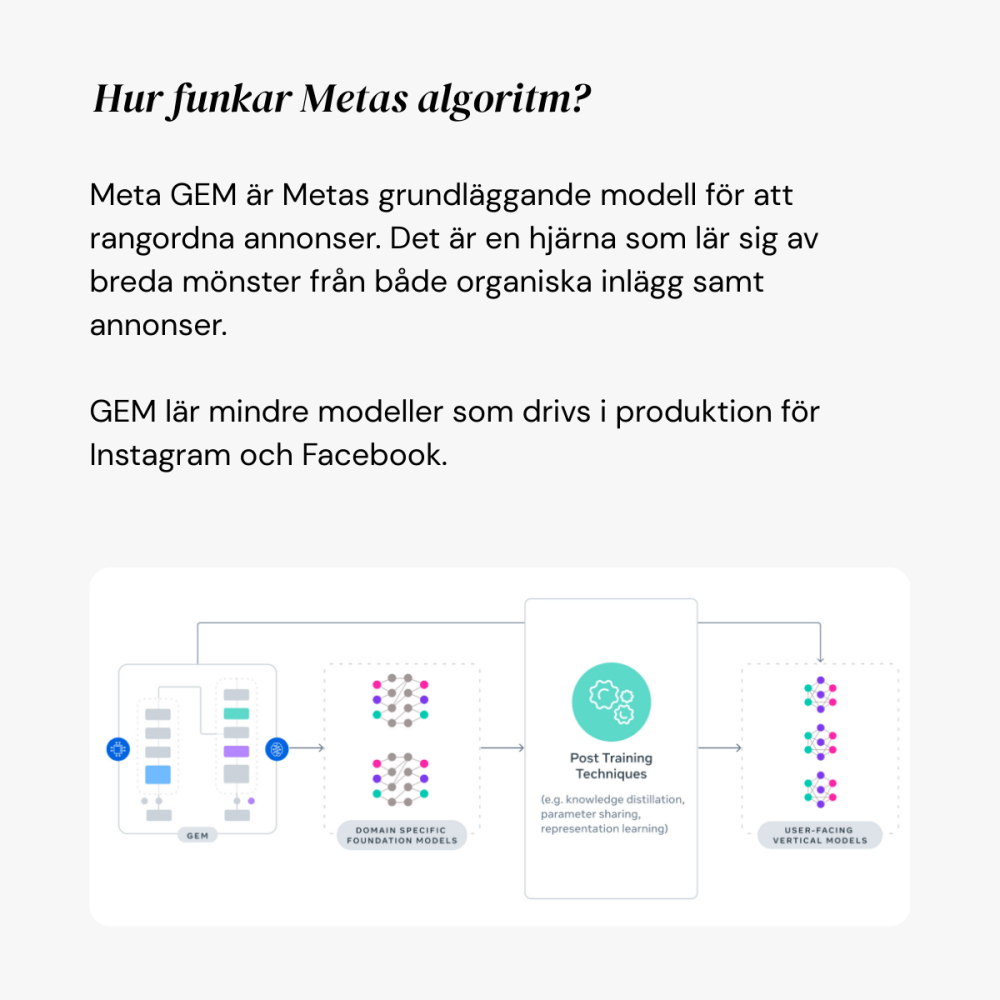
GEM is Meta’s big “brain model” for ad recommendations. It learns patterns from massive amounts of data about how people engage with content and ads, and uses that knowledge to improve how Meta ranks and matches ads to the right person at the right moment.
In other words, it's incredibly important for advertisers, media buyers and marketing executives to understand how GEM affects delivery and creative decisions.
What is the basis of GEM?
1. The model is trained on both ads and organic content, to understand at a deeper level what users care about, not just last click signals.
2. The model has two major “feature families” that are modeled differently:
a) Sequence data: user behavior over time, in order. For example, which Stories or Reels you have viewed, which ads you have paused, saved, etc. focuses on patterns over time.
b) Non-sequence data: Statistical properties that are not a time series. Descriptive facts about the user, content and context at a given moment.
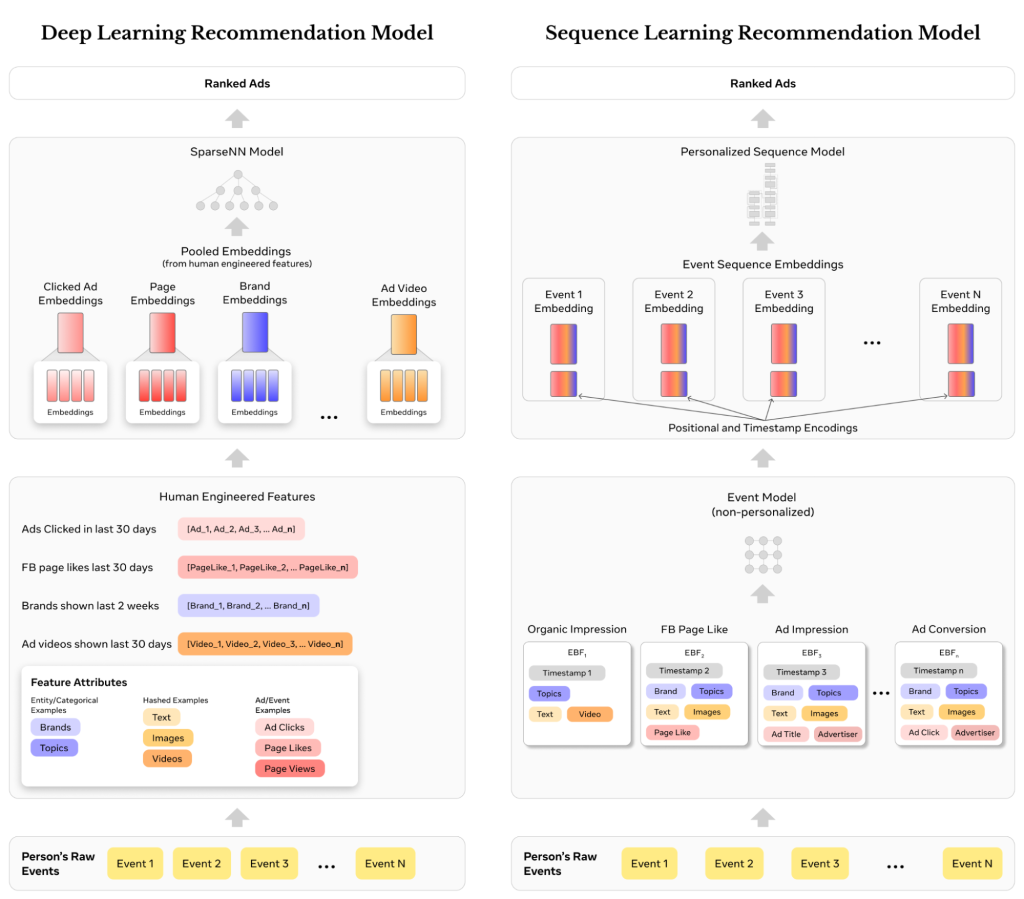
GEM uses both feature families to understand where a user is currently in their journey using the sequence data and non-sequence data to understand what the ad is and in what context it is being shown.
The goal is to understand if the ad is right for the user right now.
GEM is used as a large central model that can learn broad patterns from huge amounts of data. Since the model is too heavy to run everywhere, it is then used as a teacher that transfers knowledge to many smaller vertical models that are actually running in production.
It is these smaller, vertical models that calculate predictions for your ads in milliseconds, which are then weighed against the auction and decide what to show and when.
How to optimize for GEM in your advertising?
Is it possible to directly optimize for GEM? The answer is no.
But what you can do is create content in a way that allows models to be more likely to match your ads to the right people at the right time.
How to do this?
1. Create user journeys, not individual ads (sequence learning)
Because GEM models long behavioral sequences, it is motivated to serve ads that are reasonable within the context of a user's behavior.
You as an advertiser can take advantage of this by creating content that supports different "states of mind".
- Problem aware (Why do you know “X”)
- Solution aware (Here's what solves “X”)
- Product aware (Why this product now?)
- Offer/Decision (Offer/Warranty/Price Anchor/Proof)
Then you need to create ads in series, that is, create a series of ads that follow a logical order, adding information instead of repeating the same hook.
2. Frontload in your content (lots of information fast)
The model must quickly understand what the ad is, since the attribute of the ad is a central input in the non-sequence part, and therefore you benefit when your content makes it easy to be coded clearly, this you do by answering in your content:
- What is the product or service?
- What category/use case does the product or service have?
- Who is the product or service for?
If your opening is vague, the model gets a weaker signal of what the content is and stands for, making matching to the right audience difficult.
This does not mean that you should show a package shot of your product with a CTA button that takes up 75% of the first frame, but rather to provide clarity on who the content is for, what problem/desire, and what kind of solution it is.
3. Feed the model with a “creative vocabulary”
Since GEM acts as a teacher who generalizes patterns and passes on the lessons to vertical models, you benefit from having diversified but structured content.
This doesn’t mean you should “go crazy” and create tons of different types of content, you need a plan.
To do this, you need to build a system that is grounded in meaningful differences:
- Hook (confession, question, shocking facts, myth-bust)
- Proof (review, demo, expert, data/logic)
- Mechanism (how it works)
- Persona/avatar (who is it for)
- Offer (discount, trial, warranty)
It is important not to use random variations, but that each iteration should add a new signal to the GEM.
The Final Verdict
2026 will be won by those who build a creative system that makes it easy for Meta’s models to understand what you’re selling, to whom, and when it’s relevant.
As Meta scales up the computational power of GEM and uses longer behavioral sequences and more organic engagement data, the models will become even better at choosing the right ad at the right time.
This means that as an advertiser, you should focus on the following to win on Meta in 2026:
- Build creative families that cover different states of mind. This makes the system have something to match against in different user modes.
- Frontload Clarity: not by showing the product directly, but by quickly getting the user and model to understand who your content is for.
- Iterate with structure: add variations that add new signals (hook/proof/persona/offer), not by creating something different without a plan.
Therefore, my short but summary answer to the initial question “How to scale on Meta in 2026" is as follows:
Build a creative system that gives Meta models clear, consistent and varied signals, in a volume that matches your spend, product economics and historical data.